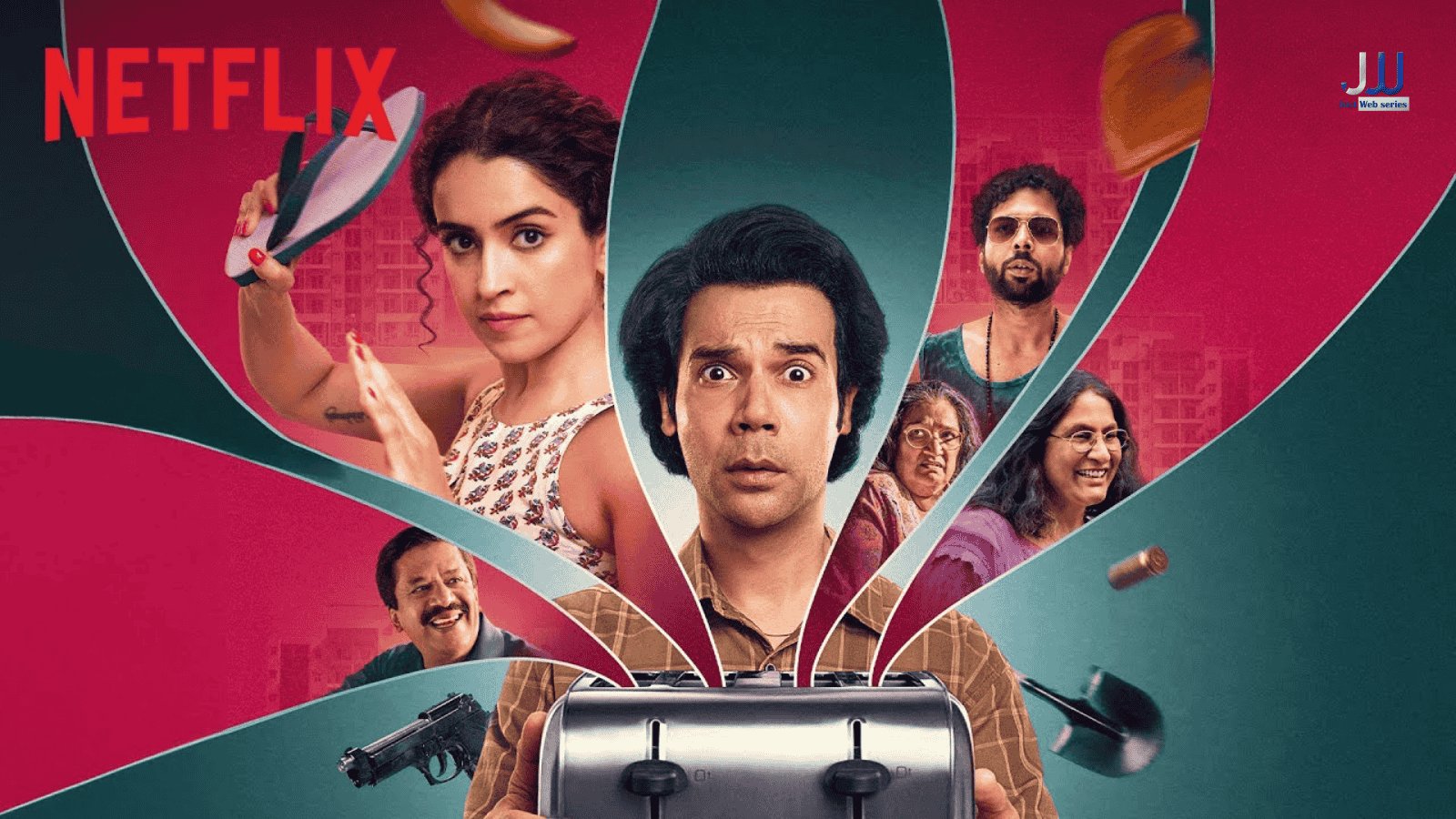

Toaster Review: You don’t expect a toaster to drive a film into chaos but here, it does. And not always successfully.
Toaster sets up an absurd, intriguing premise and pulls you in early. But as the story unfolds, the film starts to lose its grip not collapsing entirely, but drifting into uneven territory.
Starring Rajkummar Rao and Sanya Malhotra, and directed by Vivek Das Chaudhary, this Netflix dark comedy aims to blend satire, social anxiety, and escalating madness. The intent is clear. The execution? Not always consistent.
The idea is sharp. The follow-through isn’t.
Quick Info
- Release Date: April 15, 2026
- Platform: Netflix
- Genre: Dark Comedy / Thriller
- Director: Vivek Das Chaudhary
- Cast: Rajkummar Rao, Sanya Malhotra, Archana Puran Singh, Abhishek Banerjee
- Runtime: ~126 minutes
- Verdict: ⭐⭐½ (2.5/5)
Toaster Review (No Spoilers)
It follows a frugal man whose obsession with a simple toaster spirals into a chain of bizarre, chaotic events.
The narrative centres on Ramakant, a man so fixated on a wedding gift that it slowly takes over his decisions, relationships, and sense of control.
What starts as a petty concern quickly escalates into:
- Misunderstandings
- Social awkwardness
- Situations that spiral beyond logic
And that’s where the film works initially.
The premise is undeniably fresh. A toaster as the emotional trigger is absurd in the best way.
But as the film progresses, chaos builds coherence doesn’t always follow.
The first half hooks you with controlled writing and situational humour. The second half? It leans harder into randomness, often at the cost of narrative clarity.
It starts sharp, then slowly loses its rhythm.
What Works and What Doesn’t in Toaster
The performances and concept land well, but the screenplay and pacing hold the film back.
What Works
- Rajkummar Rao’s Performance
He anchors the film with a controlled, believable performance. Even when the script drifts, he doesn’t. - A Concept That Stands Out
A trivial object triggering chaos is exactly the kind of absurdity dark comedy thrives on and here, it clicks instantly. - Humour in Discomfort
The film is at its best when it pauses, letting awkward silences do the work instead of forced punchlines. - Relatable Middle-Class Anxiety
Beneath the chaos, there’s something familiar; obsession, insecurity, and the fear of losing control.
What Doesn’t Work
- Weak Screenplay Payoff
The film sets up strong ideas but doesn’t fully explore them. It builds tension, then lets it fade. - Inconsistent Pacing
The second half stretches without adding depth. Momentum slows, and the narrative starts to drift. - Underused Supporting Cast
Actors like Archana Puran Singh and Abhishek Banerjee feel present but never fully explored. - Uneven Humour
The comedy lands in bursts. In between, it feels flat.
Toaster Story & Narrative Approach
It’s character-driven and situational, but lacks structural consistency.
Toaster is less about events and more about reactions.
It avoids:
- Traditional arcs
- Clear resolutions
- Predictable storytelling
Instead, it focuses on:
- Behaviour
- Awkward interactions
- Escalating absurdity
This works until it doesn’t.
Because while the realism feels organic, the lack of structure eventually weakens impact.
At some point, you stop wondering what happens next and start wondering where this is going.

Toaster Performances Breakdown
Rajkummar Rao is the backbone of Toaster. His performance is subtle yet commanding, never overplaying the absurdity.
Sanya Malhotra stands out by adding emotional depth, ensuring the film doesn’t become a one-note dark comedy.
Supporting characters do their job but rarely leave a lasting impact, largely because the script prioritises the central dynamic.
Direction & Writing: Vision Is Clear, Execution Slightly Uneven
The vision is bold, but the control slips in the second half.
There’s ambition here; clear and visible.
The director tries to break away from safe storytelling, and that risk shows in:
- Scene construction
- Dialogue realism
- Tonal choices
But ambition alone isn’t enough.
The screenplay works in moments, individual scenes shine. But as a whole, it struggles to stay cohesive.
Dialogues feel natural, sometimes awkwardly so which suits the tone.
But that same realism can feel repetitive over time.
The film doesn’t fall apart. It just slowly loses grip.
Technical Aspects: Functional, Not Flashy
Minimal and effective until pacing exposes the cracks.
- Cinematography stays invisible, supporting the story without distraction
- Editing needed tighter control, especially in the second half
- Background score is restrained, letting silence carry tension
There’s no unnecessary stylisation which works.
But when pacing dips, the lack of technical dynamism becomes more noticeable.
Binge Factor / Theatre Value: Strictly an OTT Watch
Toaster is designed for OTT consumption, not theatrical spectacle.
Its strength lies in its intimate storytelling and character focus, making it better suited for a home viewing experience.
The pacing and tonal experimentation align more with binge-watch audiences than theatre-goers.
Audience Buzz & Reaction: Divisive but Discussable
Mixed but highly engaged.
The film is clearly dividing viewers:
- Some praise its originality and performances
- Others find it inconsistent and confusing
- Clips and moments are circulating, especially awkward scenes
This isn’t a film people agree on, it’s a film people debate.
And that, in itself, is a win.
Should You Watch Toaster?
Watch it if you enjoy:
- Unconventional storytelling
- Character-driven chaos
- Dark humour that lingers
Skip it if you want:
- Clear narratives
- Consistent pacing
- Traditional comedy
Is Toaster Hit or Flop?
Commercially, it may struggle. Creatively, it partially works.
This is not mass-friendly content.
It’s niche, experimental, and conversation-driven.
It won’t dominate but it won’t be ignored either.
Frequently Asked Questions (FAQs)
1. What is the Toaster Review verdict?
Toaster is a bold but uneven dark comedy with strong performances.
2. Is Toaster worth watching?
Yes, if you enjoy unconventional and character-driven stories.
3. Where to watch Toaster?
Toaster is streaming on Netflix.
4. What is the Toaster release date?
The film was released on 15 April 2026.
5. Is Toaster a comedy film?
Yes, but it leans towards dark, situational humour.
6. Is Toaster suitable for family viewing?
Not entirely, its tone and themes are more adult-oriented.
7. What is the runtime of Toaster?
Approximately 2 hours.
8. Is Toaster binge-worthy?
Moderately, more engaging in parts than throughout.
Final Word
Toaster doesn’t try to please and that’s both its strength and its flaw.
It starts with a compelling idea, builds intrigue, and then slowly lets that control slip. Not disastrously but noticeably.
Rajkummar Rao and Sanya Malhotra keep it grounded, even when the narrative drifts. And while the film doesn’t fully deliver on its potential, it never feels generic or manufactured.
It doesn’t completely work but it refuses to be forgettable.
And in a space crowded with safe content, that counts.




 Netflix
 Prime Video
 JioHotstar
 SonyLIV
 ZEE5
ZEE5 MX Player